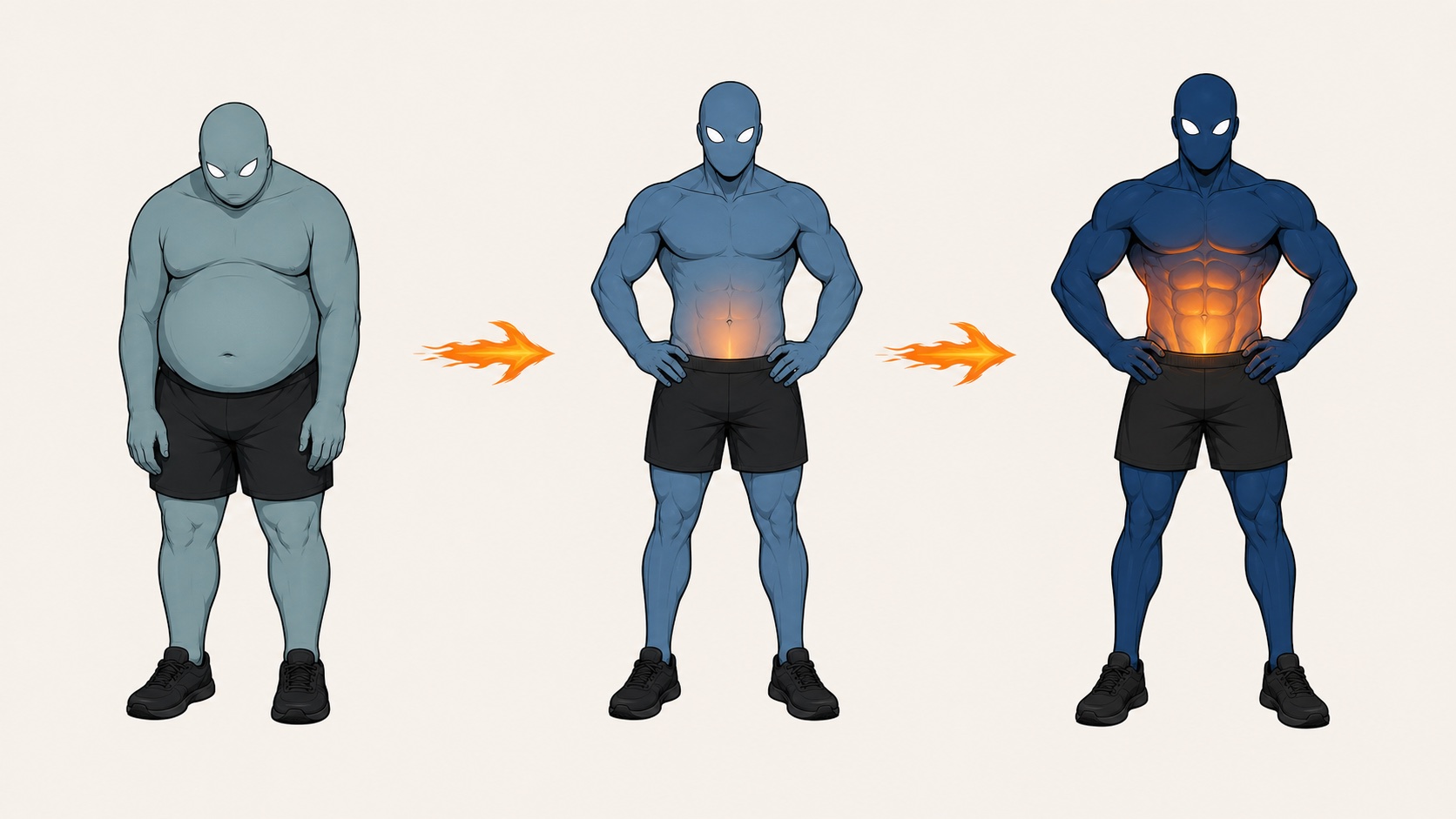
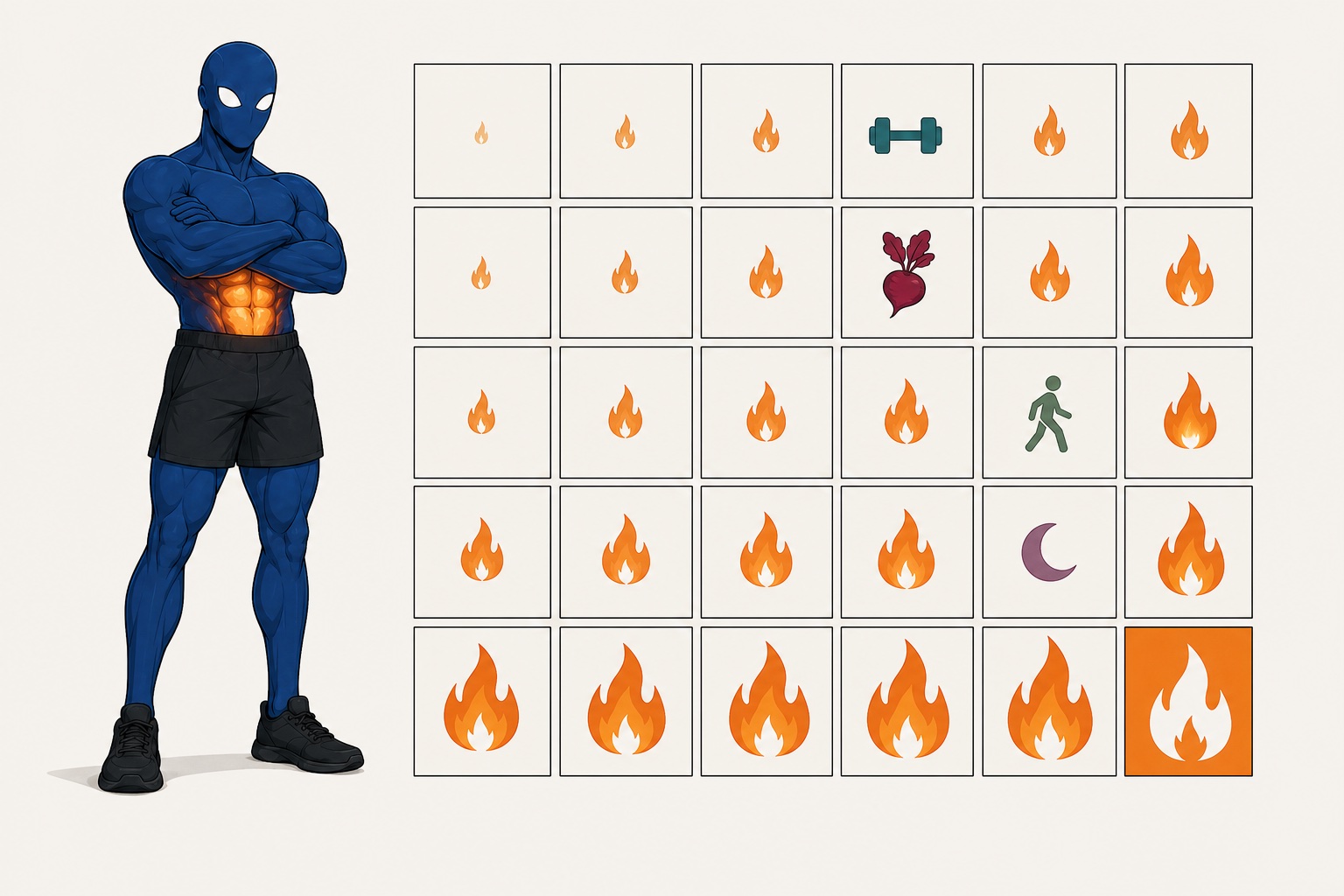
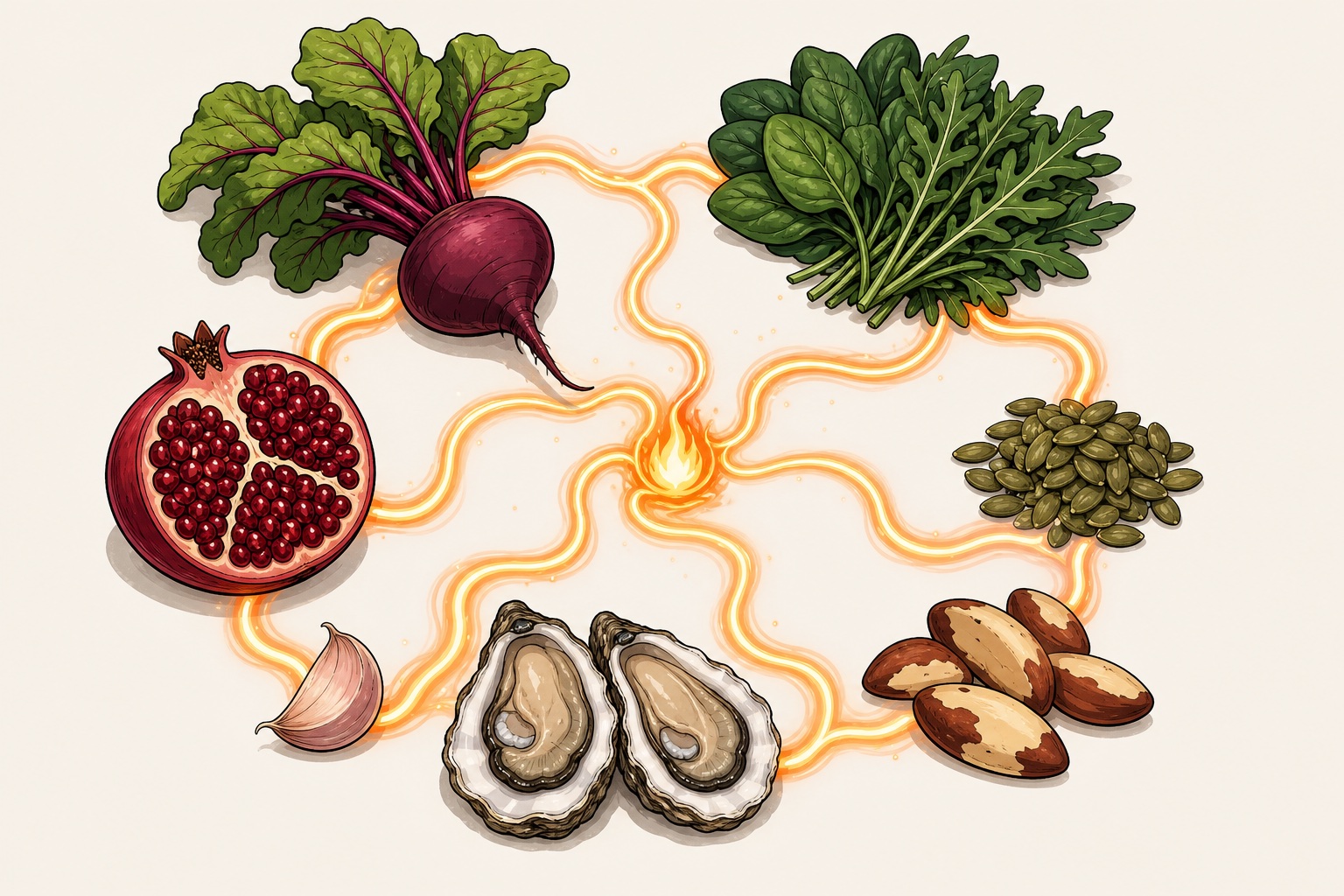
A lot of people make the same mistake — thinking you lose belly fat by dieting and training, and that it's ALL about calories. The truth is, belly fat isn't just a calorie problem — it's a system problem, and there are certain switches that decide whether your body stores it or burns it.
Even if you've failed at this multiple times. Even if you're over 40, 50, even 60. Even if you've never once got it off despite your previous attempts. Even if you're already doing everything they told you to. This is for you.
Show Me The 5 SwitchesFounding price — going up · Instant download

It's Friday night. You ate clean all week. You did — the chicken, the rice, the cardio till you feel like puking your insides out. Monday to Thursday you did not miss a beat. Then it's 11pm and you're stood at the open fridge, the leftover barbeque roast with extra hot sauce and soda to wash it down giving you the meanest look, before you know it, twenty minutes later the plate's clean. You're disgusted with yourself. But it doesn't end there, you wish! You spend your weekend stuffing all the sweet and savory goodness you can get your hands on, and all the progress you made in the week, gone like it never happened.
Saturday morning you wake up with your mouth feeling like sandpaper and your stomach so full it feels like the food is still sitting in your throat. Before your feet even hit the floor you remember the plate. Then the second plate. Then the snacks you ate while telling yourself the weekend was already ruined anyway.
You go to the bathroom, lift your shirt, turn sideways and suck it in. Then you let it out. Grab the bit hanging over the waistband. Give it a little shake like somehow this time it's going to feel smaller. It doesn't. So you put the shirt down and make yourself the same promise you've made more times than you can count. Monday. Properly this time.
Then your phone decides to finish the job. “Three years ago today.” There you are on holiday wearing that blue shirt that used to hang straight. You zoom in, and let's be honest, you're not zooming in on your face. You're looking at your waist. Comparing then to now. Before anyone beside you can see what you're doing, you swipe it away.
Or you're at a wedding, a work do, your mate's fortieth, and before you've even got a drink in your hand you've already found the wall, the chair and the angle that hides you best. The jacket stays on even though your back is sweating through it. When the phones come out you offer to take the picture. And when somebody makes the easy joke about your gut, you laugh louder than everybody else so they don't see it hit you.
You tell yourself it doesn't bother you. Of course it bothers you. And there are only two ways most men end up here. You're one of them.
For one beautiful summer the belt moved two holes. People noticed. Your face looked sharper. You bought a fitted shirt without first checking whether they had the next size up, and for once you didn't spend the whole night pulling it away from your stomach.
Then came the holiday breakfast. The “I'll get back on it when we're home.” Christmas. A nightmare month at work. Whatever it was, five pounds came back so quietly you barely clocked it. Then ten. By spring the good jeans were folded in the bottom drawer “for when,” and you were back living in the pair with a bit of mercy in the waist.
What happened was less dramatic than a broken metabolism — and far more annoying. A lighter body normally uses less energy. For some people, the body adapts a little further: hunger gets louder, spontaneous movement drops and the old portions quietly become maintenance portions. How much that happens varies. But if your plan never prepared you for any of it, the regain looks like a character flaw when it was really a plan with no second act.
You've been the man ordering grilled chicken while everybody else gets the burger and chips. You've done Dry January, the 6am sessions, the sad little plastic tub of rice eaten cold at your desk because the microwave queue was too long. You've eaten less than mates half your size, then sat there watching them order pudding.
And the gut just sat there like it had signed a 25-year lease. Eventually you stopped saying it out loud, but somewhere in your head you started believing the rules worked for every man alive except you.
The calorie rule still works. The way you were told to live with it didn't. Four spotless weekdays can be cancelled by a weekend that starts at the fridge and ends with Sunday-night guilt. Poor sleep can make hunger harder to manage. Losing muscle can leave you lighter without looking the way you expected. And no amount of crunches gets to choose where the fat leaves first. The deficit matters. So does building a body and a routine that can hold one without making you miserable.
And this is the part nobody sees when they look at you.
You didn't wake up one morning and decide to “let yourself go.” It happened at 11pm, ten minutes at a time, while you were busy keeping everything else going. The promotion that swallowed your evenings. The kids who needed feeding while your own dinner went cold. The mortgage that meant you couldn't just tell your boss where to stick the job. The parents getting older. The phone that never, ever stops going off.
Somewhere in the middle of all that, food became the one part of the day that didn't ask you for anything. The beer you earned. The takeaway nobody had to cook. The ten minutes in front of the fridge after everybody else went upstairs.
That's not a weak man. That's a tired man grabbing the easiest bit of comfort left. The problem is, do that for long enough and those ten-minute comforts start showing up on the front of you.
Maybe you lost the belly and watched it crawl back. Maybe it never went anywhere. Different story, same thing you say when nobody else can hear you: “It must be me.”
It isn't. Your body is not broken, and there is no mystical “storage mode” trapping every calorie in your stomach. But there is a system: how much energy you use, how your muscle handles glucose, how much lean tissue you keep, how stress and sleep change your appetite, and whether the way you eat can survive a real Friday night.
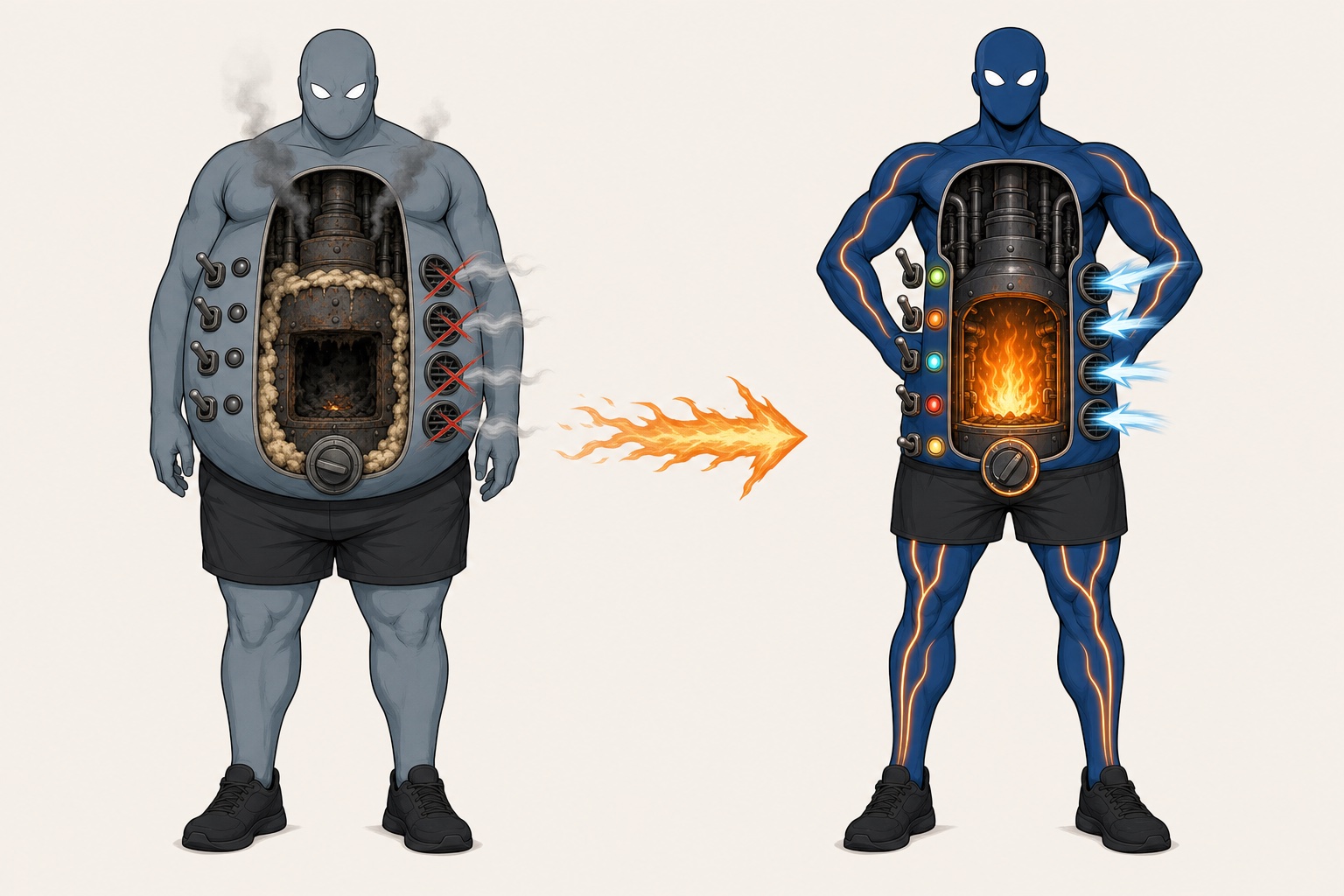
You kept taking fuel out of the furnace. Nobody showed you the controls that make the deficit easier to create, easier to use and far easier to keep.
Before I show you those five switches, let me show you what getting this right looks like in real life.
This is what you're really buying
Same hotel. Same pool. Last year you picked the lounger right against the wall, kept your T-shirt on while pretending to be deeply interested in your phone, then waited until the last possible second to take it off before getting in. Stomach pulled in so hard you could barely breathe. At lunch the wet shirt went straight back on. Horrible feeling, but better than walking around without it. Or so you told yourself.
This time you drop the towel, pull the shirt over your head and leave it on the chair. You don't scan the crowd. You don't do that stupid little thirty-second argument in your own head. You just get in the pool.
Ten minutes later you've forgotten the shirt even exists. That's the thirty pounds. Not some number flashing on a scale in your bathroom. That.
And that's when it starts showing up in all the little places you forgot it was costing you.
Tuesday morning. Nothing special. You put on the white work shirt and the buttons just close. No little star-shaped gap over the stomach. No standing in front of the mirror pulling the fabric down and wondering if anybody will notice.
Later, somebody you see every week stops halfway through a sentence, looks at you properly and goes, “Mate... have you lost weight?” You give them the casual nod. Yeah, a bit. Like it's nothing. Meanwhile that one sentence carries you through the rest of the day.
Saturday afternoon one of the kids shouts “Race you” and takes off before you've even agreed. Normally you laugh, point at the dodgy knee and let them win by default. Not this time. You go. Full sprint. Terrible start, keys smashing against your leg, both of you laughing before you even reach the gate.
They don't care what your body-fat percentage is. They just know Dad actually joined in.
Then somebody's fortieth. The room is roasting and for once the jacket actually comes off. When a phone appears and everybody squeezes together, you don't slowly drift towards the back. You don't suddenly become the official photographer. You step into the gap, arm around your mate, and face the camera straight on.
The photo lands in the group chat the next morning. Usually you'd zoom straight in on your stomach, hate it, then never look at it again. This time? You save the bloody thing.
And the best bit? Eventually it becomes boring. You stop planning every outfit around the gut. Stop checking your side profile in every shop window. Stop treating Monday morning like the grand opening of another punishment camp. Your body isn't the loudest thought in your head every time you walk into a room.
That's the thirty pounds. Not what disappears from the scale. What comes back into your life.
But there's one thing you need to stop doing before a single pound moves.
Stop calling yourself the bloke who “always falls off.” Because every time you say that, one bad plate becomes a bad weekend. One missed workout becomes “I'll start again Monday.” Then Monday becomes next month and somehow you're back at the fridge wondering how it happened again.
You do not need to wake up tomorrow as some brand-new man who loves broccoli and jumps out of bed at 5am smiling. You just need to do tomorrow's instruction. Then do the next one when it arrives.
Thirty normal days. One promise kept at a time. That's how this finally stops being another attempt.
Calories decide the direction. Muscle, movement, sleep, appetite and metabolic health decide how rough the road feels—and what you keep while the weight comes off.
Meet the five
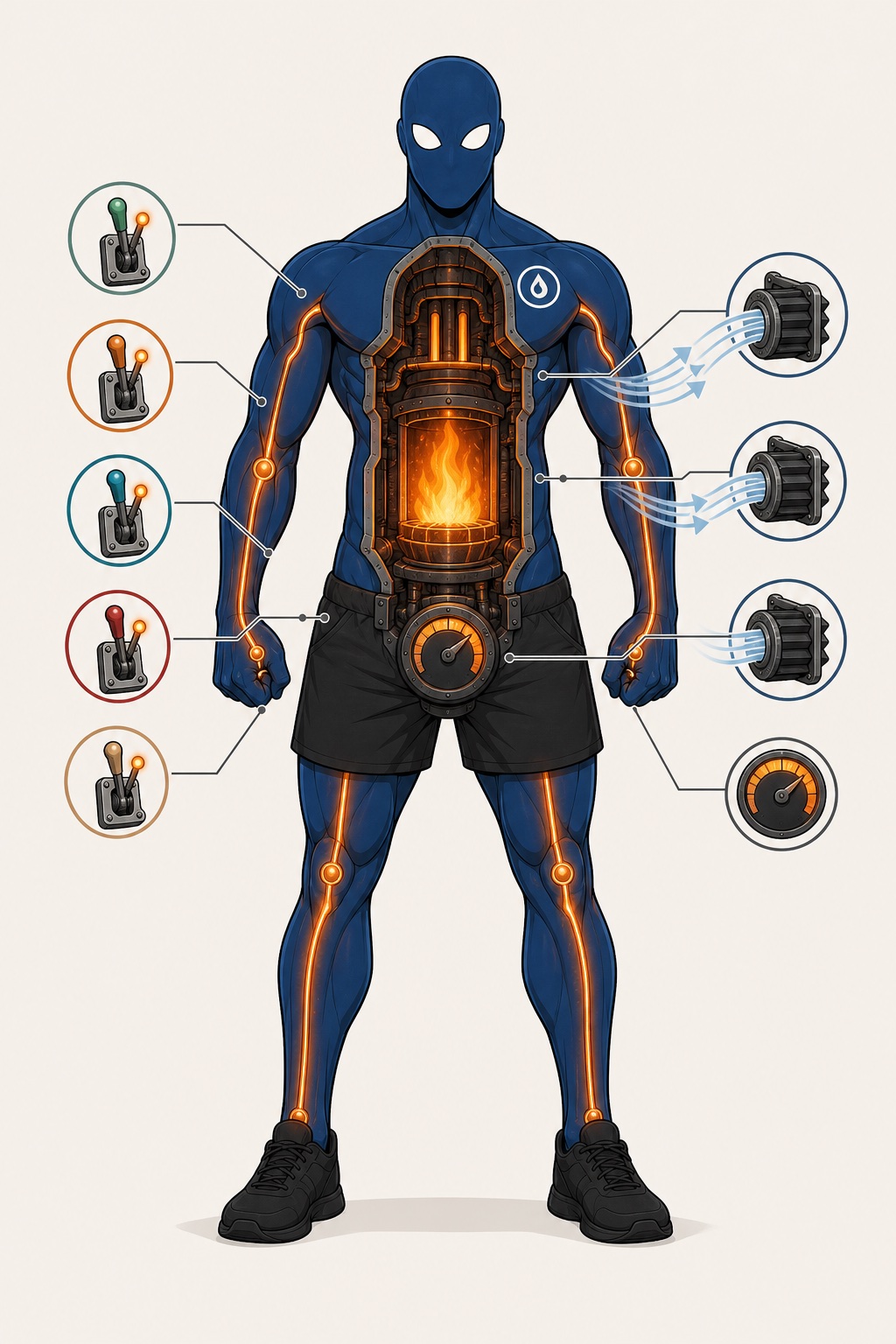
Five interconnected levers, all pulling on the same job. Flip them together and you stop fighting your body for every pound — it starts doing the work with you.

Decides where every meal ends up — muscle, or the front of you. Get it answering properly and your food starts landing somewhere useful.

Your belly fat runs its own supply of it, and carries the receptors to catch it. That's the physical reason stress lands there.

Sets your fullness signals. Get it right and the 11pm fridge stops being a fair fight — on exactly the same calories.

Belly fat runs an enzyme that converts it to estrogen. Less T, less muscle, more fat, more enzyme. It tightens on its own.

The biggest place your body can put glucose, and the tissue that sets your daily burn. Build it and the furnace gets bigger.
And every one of them is wired to the others. Muscle gates insulin. Fat gates testosterone. Testosterone gates muscle. Cortisol gates the entire evening. That's why hitting one and ignoring the rest bought you four good weeks and nothing that stayed — and it's exactly why working them together compounds instead of fading. You build the foundations, then put your weight behind the one that's actually holding you up. If that one turns out to be medical — persistent symptoms, abnormal blood sugar, possible low testosterone — that goes to a clinician, not a checkout page.
What each switch actually does
The switch is the metaphor. What sits underneath it is real machinery — enzymes, tissues and signals that decide where your food goes and what your body does with it. Once you can see the machinery, you stop guessing.

Every meal you eat has to be sent somewhere. Insulin is the dispatcher, and skeletal muscle is by far the biggest destination it can send glucose to. Trained, insulin-sensitive muscle takes that glucose out of your blood fast and packs it away as glycogen — fuel for the next session.
When that muscle stops answering, the dispatcher has to shout. Your body raises the insulin signal to get the same job done. Higher background insulin also puts a brake on releasing stored fat between meals — which is the part nobody mentions. Poor glucose control and a thickening waist sit in the same picture for a reason: each one makes the other harder work.
Here's the part worth paying for: this is not fixed. Resistance training, regular daily movement and losing fat all improve how well your muscle answers insulin. Improve it and two things happen at once. More of what you eat gets routed into the tissue you're trying to keep, and your body has less of a brake on burning the fat you're trying to lose. Same plate of food. Completely different destination.
You're not trying to kill insulin. You're building a body that barely needs to raise its voice. (Persistently high blood sugar is a clinician's job, not a checkout page's.)

Cortisol isn't poison. It's an emergency system — built for a threat, a sprint, then over. But nothing about your week is short. The 1am email. Five hours' sleep. A drive home spent arguing with people who aren't even in the car. Your body can't tell a predator from a Monday, so the emergency never switches off. Most men over 35 run fight-or-flight permanently without one symptom they'd recognise.
And an emergency system is disruptive by design. It makes decisions that are brilliant for ninety seconds and ruinous across ninety days: glucose dumped for a sprint you never take, digestion and repair shoved down the queue, the sleep you need to recover wrecked, and the side of you that holds muscle worked against.
Then there's why it lands on your gut and not your arms. The fat around your organs carries an enzyme called 11β-HSD1, which pulls spent cortisone from your blood and regenerates it into active cortisol — inside the fat cell itself. That fat is also denser in cortisol receptors than anywhere else on you. Your belly isn't soaking up your stress. It's running its own supply line.
Here's why it's the most fixable of the five. You won't meditate your way out of a mortgage, and you don't need to. What lowers the load is mostly scheduling: sleep back towards seven hours at consistent times, early daylight, walking instead of stewing, caffeine out of the afternoon, training that stops short of wrecking recovery, less alcohol, and meals that don't leave you starving at 10pm.
Not one thing on that list takes an hour or a retreat. (Ordinary stress is not a clinical cortisol disorder — that one belongs to a doctor.)

Nobody abandons a diet because their microbiome failed a hidden test. They abandon it because lunch was a dry protein bar, dinner left them hungry and by 11pm the kitchen was winning. That's the version you feel. Your gut runs a lot more than that.
Start with the obvious one: everything you're eating for this only counts once it's absorbed. The protein for your muscle. The iron and B vitamins behind your energy. The magnesium and zinc your recovery and hormones lean on. A gut that's irritated, inflamed or badly fed doesn't extract what you paid for — so you can eat an excellent diet and still run short.
Then there's appetite, decided far lower down than willpower. Fermentable fibre feeds the bacteria that produce short-chain fatty acids like butyrate, which fuels your gut lining and keeps that barrier intact. The same fermentation drives the hormones that tell your brain the meal is over. Get this right and you stop white-knuckling the deficit — you're simply less hungry on the same calories. It reaches past food, too: most of your immune tissue sits along your gut, most of your serotonin is made there, and research links a disrupted barrier to the low-grade inflammation that travels with insulin resistance.
It's not a padlock, though. There's no proven “gut reset” that unlocks a stubborn belly. The real win is unglamorous: fibre-rich plants, enough protein, mostly minimally processed food, and a structure your digestion tolerates.
Feed it properly and you're not just fixing digestion — you're improving absorption, appetite, recovery and mood at once. This is the switch that makes every other switch repeatable.

The internet sees a tired man with a gut and diagnoses him before breakfast. Low testosterone. Buy this booster. Take these capsules. Feel twenty-five again by Friday. Brilliant sales pitch. Rotten medicine. Your belly is not a blood test.
But the relationship underneath it is real, and it runs in a circle. Fat tissue carries an enzyme called aromatase, and aromatase does exactly one thing: it converts testosterone into estrogen. More fat tissue means more aromatase activity. More aromatase activity means less of the testosterone you produce survives as testosterone. And lower testosterone makes it harder to build and hold muscle.
You already know what losing muscle does. Less muscle means worse glucose handling and a smaller daily burn. Which means more of what you eat gets stored rather than used. Which means more fat tissue. Which means more aromatase. That's the loop, and it tightens quietly, on its own, while you're busy blaming your age.
Here's the useful half: it runs backwards too. Meaningful fat loss has been shown to improve testosterone levels in men carrying excess weight. So dropping the fat and holding the muscle isn't two jobs — it's one attack on the same loop, hitting it from both ends at once. Every pound off the front of you is one less pound converting your testosterone into something else.
Persistent symptoms deserve a clinician and a proper blood test — not a label printed on a supplement tub. What you can act on today is the fat and the muscle.

Muscle will not sit there at midnight incinerating yesterday's takeaway. More muscle is not a free pass on calories, and a hundred crunches does not order your body to take fat off your stomach. Anyone selling you that is selling you the last four attempts again.
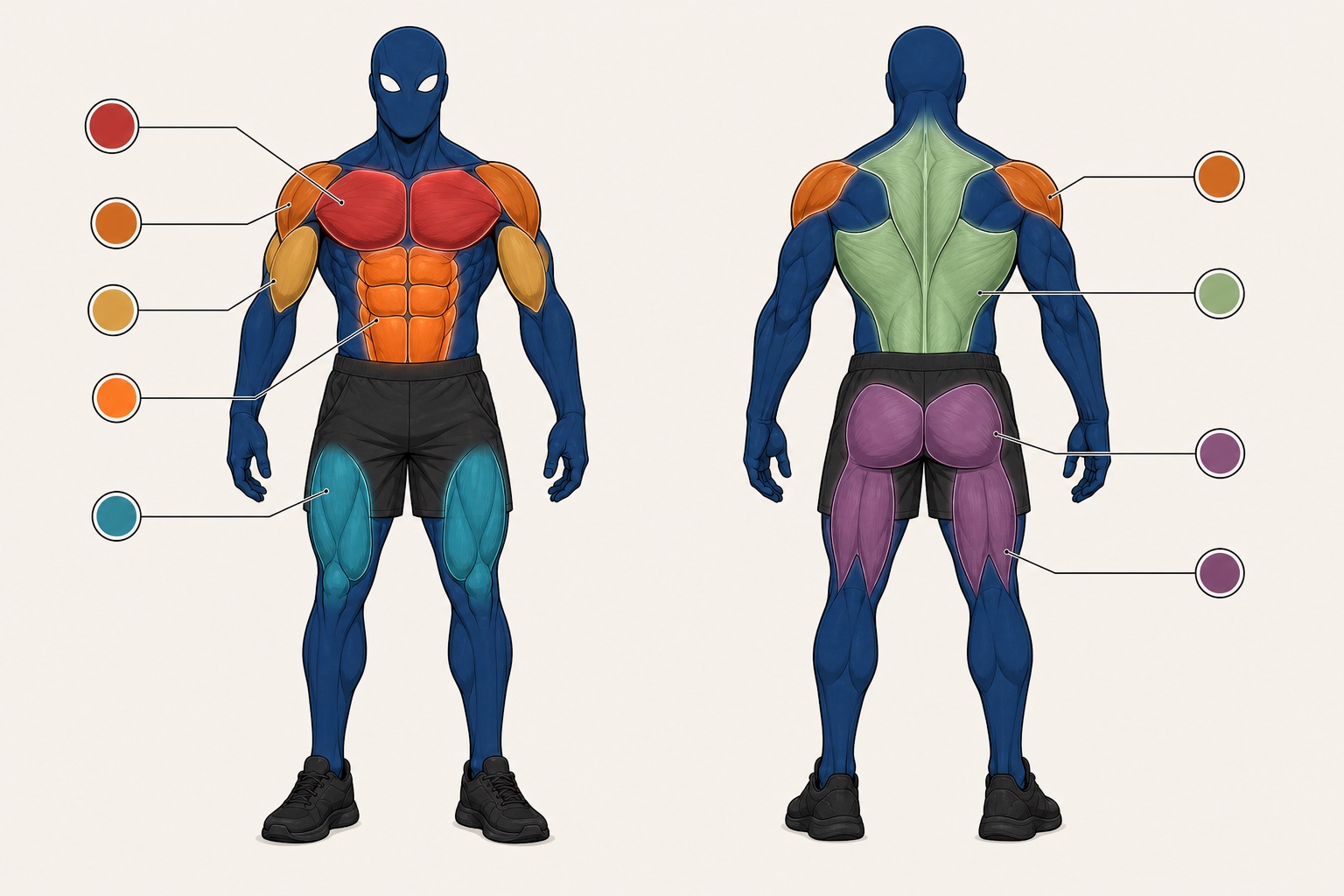
What it actually does is better. Skeletal muscle is the largest site of insulin-stimulated glucose disposal in your body — the single biggest place your food can go that isn't your waist. Train it and you create genuine demand for glycogen, so the carbs in your next meal have somewhere to be. Hold onto it through a deficit and far more of what you lose comes off as fat instead of the tissue that gives you your shape.
And it raises what you spend. Lean tissue costs energy to carry and to repair. The training itself costs energy on the day. A stronger body moves more without being told to. That is your daily burn going up while the tape goes down — which is the exact opposite of what happened on every crash diet you've done, and the entire reason that weight came back.
You can't pick the postcode the fat leaves first. You can absolutely decide what's still standing when it does.
You can finish fasted cardio having used plenty of fat for fuel, eat it all back by lunch and lose nothing that week. Meanwhile another man lifts weights, burns mostly carbohydrate in the session, ends his week in a sensible deficit and loses body fat. Same seven days. Opposite results.
Your body switches fuel all day long. Fat oxidation tells you what it's using at 7:40am. Net fat loss tells you what was left over once the entire week was added up. One is a moment. The other is the tape measure.
So stop buying the minute and start buying the week. This is exactly where the five switches earn their money, because every one of them moves the weekly number rather than the moment. Better insulin sensitivity routes more of your food into muscle and takes the brake off releasing stored fat. More muscle raises what you spend every single day. Sleep and cortisol decide how much you eat when nobody's watching. Gut health decides whether you're hungry at 11pm. Those four things move the tape. Sweating harder in minute twenty-seven doesn't.
Fat-burning zones, sweat and empty-stomach workouts feel like proof. An inch off the tape on day 30 is proof.
The calculator hands you one neat number because calculators hate real life. What you actually spend is four separate things: your resting needs, every step you take, your training, and the energy used digesting your food. All four of them move — and three of them move on your instruction.
As you get lighter, a smaller body needs less. You may also start moving a little less without ever noticing. Some men get an additional adaptive drop on top of that; others barely register one. There's no honest universal figure claiming every man loses the same 300 calories of daily burn.
Here's the leverage, and it's the whole reason the last thirty pounds came back. Resistance training and enough protein defend the lean tissue that carries your resting spend. Daily movement defends the part of your expenditure that quietly disappears the moment work gets busy. You aren't abolishing adaptation — you're refusing to hand your burn rate back without a fight. That is the difference between losing thirty pounds and keeping thirty pounds off.
A stall is data, not a verdict. It tells you what to adjust — not that your body is broken or that you should starve it harder.
Now you can see why the five belong on one page.
Muscle sets how well you handle glucose and how much you spend all day. Cortisol sets how much you eat at 11pm and how well you recover. Gut health sets whether you finish a meal full or hunting. Testosterone sets how much muscle you can hold — and the fat on the front of you is actively working against it. Energy balance decides whether stored fat comes off. Everything else decides whether you can hold that balance long enough for it to matter.
And worked together, they compound. Better insulin sensitivity makes your training more productive. More productive training builds more muscle. More muscle raises your daily spend and improves your glucose handling. Protected sleep defends all of it and keeps you out of the fridge. That's five things pulling in one direction — instead of one heroic effort pulling against the other four. It's also why this doesn't stall out in week three like everything else you've tried.
They are connected, but they are not a secret sequence and they are not a diagnosis. What you get is a practical structure: train, move, build meals that satisfy you, protect your sleep, track the waist trend and take medical questions to a clinician.
No single switch melts a gut. Work the whole system long enough and the waist finally has a reason to follow.
Every scientific claim in the guides is sourced. Associations are labelled as associations, small trials are labelled as small trials, and uncertainty is not edited out to make the sales pitch louder.
Founding price — going up · Instant download
The bit you already tried
You've done the counting. You know you have. Nine days of weighing the chicken, logging every biscuit, watching the little circle close green before bed. And it worked — for nine days. Then you were in a Tuesday meeting, someone had brought pizza in, and you took a slice and didn't log it, because logging it would've made it real. That was the day the app quietly died on your phone.
The number was never fake. The idea that you had to stare at it forever was. A sustained energy deficit is what reduces stored body fat. You can create one by tracking every gram, using repeatable portions and meal structure, changing food choices, increasing activity—or some combination that you can actually live with.
But the target from day one will not sit still forever. A lighter body generally uses less energy. Busy weeks can quietly cut your steps. Hunger can rise. Some people get an extra adaptive drop in expenditure and some get very little. The size of that change varies—which is exactly why a fixed “metabolic damage” number is more theatre than science.
So if the scale and tape stop moving, you do not hold a trial in the bathroom and find yourself guilty. You check the trend. Check the weekends. Check portions, steps, training and sleep. Then make the smallest useful adjustment instead of chopping another meal out and hoping misery proves commitment.
That is the honest job of the furnace. Not to make calories disappear. To change what your body does with them — and to make the deficit something you can actually hold long enough to finish.
Because the same 2,200 calories do not behave the same way in two different bodies. Where the fuel gets sent is called nutrient partitioning, and every one of the five switches has a hand on it. This is the part “eat less, move more” never told you, and it's the reason two men eating identically end up looking nothing alike.
Insulin sensitivity decides the routing. Muscle that answers insulin properly pulls glucose out of your blood and stores it as glycogen — fuel waiting for your next session. Muscle that doesn't answer forces your body to raise the insulin signal, and higher background insulin puts a brake on releasing stored fat between meals. Improve sensitivity and you flip both: more of what you eat lands in the tissue you want to keep, and there's less holding back the fat you want to lose.
Muscle raises what you spend, in three separate places. It costs energy to carry. It costs energy to repair. And training it costs energy on the day, on top of a body that simply moves more because it's stronger. That's your daily burn getting bigger while the tape gets smaller — the exact opposite of the crash diet, which shrinks the burn and the man together.
Testosterone protects the engine while you're in the deficit. Healthy levels support building and holding muscle, which is what keeps that burn where you want it. And because fat tissue carries the aromatase enzyme that converts testosterone to estrogen, losing the fat and keeping the muscle are hitting the same problem from both ends.
Then cortisol and gut health decide how much of the plan survives contact with a Thursday. Short nights make hunger louder and recovery worse. Protein and fibre decide whether you finish dinner satisfied or hunting. Neither one changes the arithmetic. Both of them decide whether you're still doing the arithmetic in week six — and week six is where every previous attempt died.
Put that together and you get a body that spends more, routes food better, holds onto its muscle and is genuinely easier to feed. That's a furnace you can keep. Starving yourself smaller just gives you a smaller man with the same problem and less muscle left to fight it with — which is precisely why it came back last time.
None of this cancels thermodynamics. It moves both sides of the equation in your favour and makes the deficit liveable. That's the only reason anybody ever keeps it off. Use numbers when they help. Use structure when it works better. But never confuse “calories matter” with “calories are the only thing worth teaching.”
The guides distinguish normal changes from adaptive thermogenesis and explain the wide individual variation. They do not diagnose a “damaged metabolism.”
First, I'm not a doctor. I'm not going to put on a white coat, stand in front of a bookshelf and pretend that makes me one either. This is education, not medical advice. The mechanism is explained, the studies are attached, and you can check every claim yourself or take it straight to your doctor.
Second, be patient with the result. Your waist may start moving before day 30. It may take longer. Water, starting point, health, sleep, medication, training history and consistency all change the timetable. The calendar tells you when to do the work; it does not get to tell your body the exact morning the tape must move.
Third, it takes work. On workout days, you work out. You follow the meal timings. You shop, prepare and show up when the first-week buzz has worn off. And when you miss something—as every real person eventually does—you do not sweat, sulk or turn it into a lost weekend. You return at the next meal or the next session.
Come with the mentality of a winner before the mirror gives you proof. A winner is not the man who never misses. It is the man who refuses to let one miss become his identity. No miracle. No fake doctor act. No work done by magic.
Now let me show you exactly what your nineteen dollars gets you.
The whole lot · $19
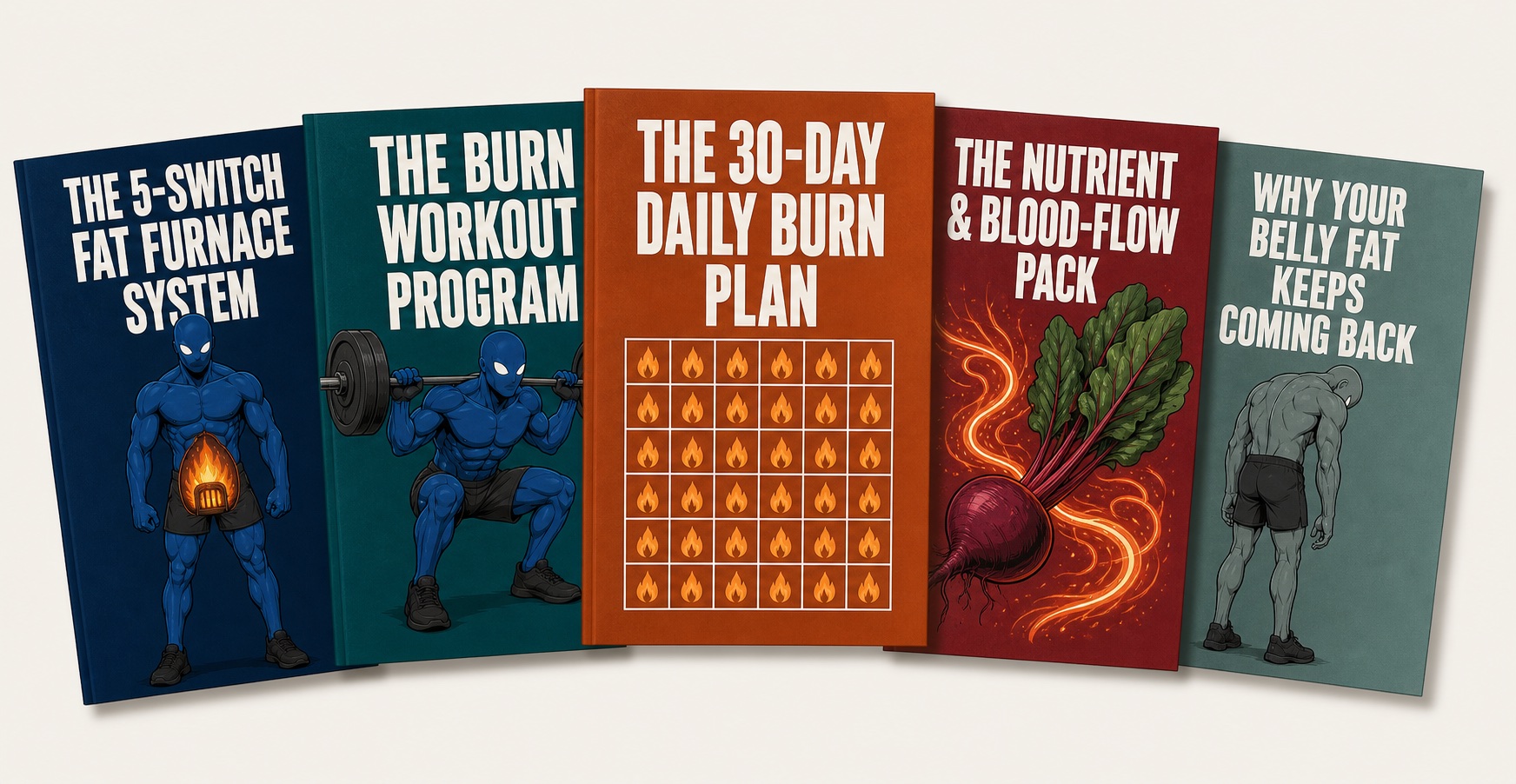
Five guides. No members' area with 97 videos staring back at you. No “welcome module” before you get to the useful bit. You open the email and the whole thing is sitting there — the system that tells you what's actually holding you up, the training that protects your burn, the food that kills the 11pm hunger, and thirty mornings of instructions so you never have to decide anything.

This is the one you read first, and it's the one that ends the guessing. It shows you the entire machine — where your food gets routed, what sets your daily burn, why the last four attempts came back — and then shows you which of the five switches is holding you up. By the time you finish it you'll understand your own body better than the last three people you paid for advice. Every scientific claim comes with context and a source, so you can check it or take it straight to your doctor.

No more wandering the gym doing a bit of chest, a few curls and twenty miserable minutes on the treadmill because the machines you wanted were busy. You walk in knowing exactly what you're building and why. This is the training that defends your muscle while the fat comes off — and that single fact decides whether you end up lean at the end of this, or just a smaller version of the same man.

This is the bit that stops the whole thing becoming another PDF you read halfway through and forget. One email lands each morning with one instruction. You do it and get on with your life. No planning, no deciding, no willpower spent before breakfast — because the reason the last plan died wasn't that you didn't know enough. It's that every single day asked you to choose. Thirty days later you have the habit, the logged proof and the first inch off the tape.

Before another bottle with lightning on the label finds its way into your cupboard, read this. It builds your meals around fullness, training and glucose handling — so the deficit stops being a fight you lose at 11pm every night. This is the guide that makes the whole thing survivable, and survivable is the only kind that ever works.
This is the field guide to every rigid DON'T, miracle shortcut and half-true rule that ever made one bad meal feel like total failure. And that matters more than it sounds: guilt is the mechanism that turns one plate into a ruined weekend. Take the guilt out and a slip stays a slip.
Put together, that's the entire job covered. The system tells you what's actually holding you up. The training keeps the muscle that keeps your burn high. The food makes the deficit something you can live inside. The daily emails make sure you do it. And the last guide stops one bad plate from taking the weekend with it.
Which is how you get to next summer and drop the towel without the thirty-second argument in your own head. Not because you found more willpower than you had last time. Because for once you were working with the machine instead of starving it and hoping.
Add it up
| The 5-Switch Fat Furnace System | $47 |
| The Burn Workout Program | $27 |
| The 30-Day Daily Burn Plan | $27 |
| The Micronutrient & Bloodflow Mega Pack | $17 |
| Every Fat Loss Lie You Have Ever Been Told (And Why They Never Work) | $11 |
| Total value | $129 |
Founding price — going up
You pay
All five guides. One payment. Straight into your inbox.
Get The Fat Furnace — $19Secure checkout · Instant access · Access emailed immediately
Because let's be honest, sometimes $19 makes you more suspicious than $129. At $129 you think, must be serious. At nineteen bucks you start looking around for the hidden subscription, the rubbish upsell or the bit where I tell you the guide only works if you buy another $80 worth of powder.
There isn't one. The reason is painfully simple. A $129 program can sit unopened in your inbox just as easily as a $19 one, and you've probably already got a forgotten login somewhere that proves it.
I want this to be easy enough for you to get started without a big commitment. I need you to open day one tomorrow morning and actually do it. This is ten years' worth of mistakes I have made through years of false information and struggling to get my best results. I don't want you to spend ten years.
That's the deal. You get the founding price. It will go up with time, so if you're here now, welcome aboard!
I'd rather you close the tab now than buy it, do nothing and add The Fat Furnace to the pile of things you say “didn't work.”
Not because insulin locks another click at midnight or one missed workout permanently slows your metabolism. The switch is shorthand for the system you keep rehearsing.
Live the same week again and the old pattern gets another rep. Inactivity means fewer muscle contractions supporting glucose handling and fewer sessions preserving strength. A recurring energy surplus can add body fat, including around the waist. Fitness and daily movement can drift down, while short sleep keeps making appetite, recovery and the late-night kitchen harder to manage. None of that happens in one dramatic day, and none of it is irreversible. But direction compounds.
The good news is that it compounds both ways. One workout becomes a week of workouts. One meal you recover from becomes a weekend you no longer throw away. Every day you wait gives the old default another rehearsal; every day you act gives the new one a vote. You don't need panic. You need the first rep.
Still here? Good. Then I don't care if you've lost the belly four times and put it back on five. I don't care if you've never once managed to shift the thing. Your history doesn't disqualify you.
The only question that matters is this: when tomorrow's instruction lands, will you do it before life gets a chance to talk you out of it?
Bring the same standard you brought to every other part of your life: show up, learn, adjust and carry on.
Get The Fat Furnace — $19Founding price — going up · $129 $19 · Instant download
Of course you can. Open another tab and ask it right now. It can collect the usual advice about calories, sleep, stress, protein and lifting. Most of that information will be perfectly reasonable. Information was never the bit I spent ten years missing.
I spent those years trying the plans, swallowing the false starts, making the mistakes and learning what actually survives a bad night's sleep, a late meeting and a Friday that goes off the rails. The Fat Furnace is not general internet slop swept into a PDF. It is the system that came out the other side of that lived experience.
That includes a precise implementation sequence: what you set up first, how the meals and workouts support each other, and what you do the morning after you miss. It is not a claim that every human body has one secret biological order. It is the practical order I refined so you do not have to improvise the next move every day.
No amount of prompting can give a model the ten years I spent learning those decisions the hard way. If you want to research, compare and build your own version, keep the $19. If you want the lived mistakes removed and tomorrow already mapped out, that is what you're buying.
Your situation is different. Your starting weight, health, medication, sleep, injuries, food environment and training history all matter. The five switches are a way to see where the friction is—not a quiz that diagnoses a “stuck switch.” You keep the shared foundations and adjust the plan to the life and body actually in front of you. Medical questions go to a qualified clinician.
Because it does not ask one trick to carry the whole job. It connects the energy deficit to resistance training, daily movement, meal structure, protein, fibre, sleep and recovery. It explains insulin sensitivity, nutrient partitioning, metabolic expenditure and fat oxidation without pretending any one of them melts your stomach. Then it turns the explanation into tomorrow's instruction.
All five guides arrive the second checkout is done. Then the 30-Day Daily Burn Plan comes one email at a time for thirty days. Tomorrow's instruction arrives tomorrow, instead of you opening a ninety-page PDF tonight, feeling productive for twenty minutes and never making it past page twelve.
It is a fat-loss system, so food matters and a sustained energy deficit still matters. What it is not is a crash diet or a universal calorie target. The meal structure, portions and timings are tools for creating a manageable deficit while supporting training and fullness. Biology does not do the work for you; the system helps you work with it.
No honest program can choose the order. Crunches train abdominal muscle; they do not instruct the body to remove the fat sitting over it. Your waist changes as overall and visceral fat fall, and the pace differs from person to person. We measure the waist because that is the result you care about—not because the system claims spot reduction.
No. Age can change recovery, muscle mass, health and the size of the job, but it does not cancel your ability to gain strength, improve fitness or lose fat. Start from your actual capacity, progress it and speak to a clinician if symptoms or medical conditions need assessing. No scare story required.
A gym gives you more loading options for the compound lifts in the Burn Workout Program. Much of the system does not need one, and the program includes substitutes for missing equipment or the machine somebody has been sitting on for forty minutes scrolling through Instagram.
Yes—we include them, but not a shopping trolley full of pills. The Micronutrient & Bloodflow Mega Pack gives you the short, evidence-led list you may actually need or reasonably consider, what each one is there to support and when it has not earned a place.
Food, training and sleep remain the foundation. No supplement selectively burns belly fat, and the bottles are not included—we do not sell supplements. “Need” depends on your diet, deficiencies, health and medication, so check with a clinician or pharmacist before starting one if you have a medical condition or take medication.
The email takes about a minute to read. Most daily actions take around ten minutes and use things you're already doing, just in a different order, at a different time or at a different intensity. Workout days obviously take longer. I'm not going to pretend you can do a proper session while the kettle boils.